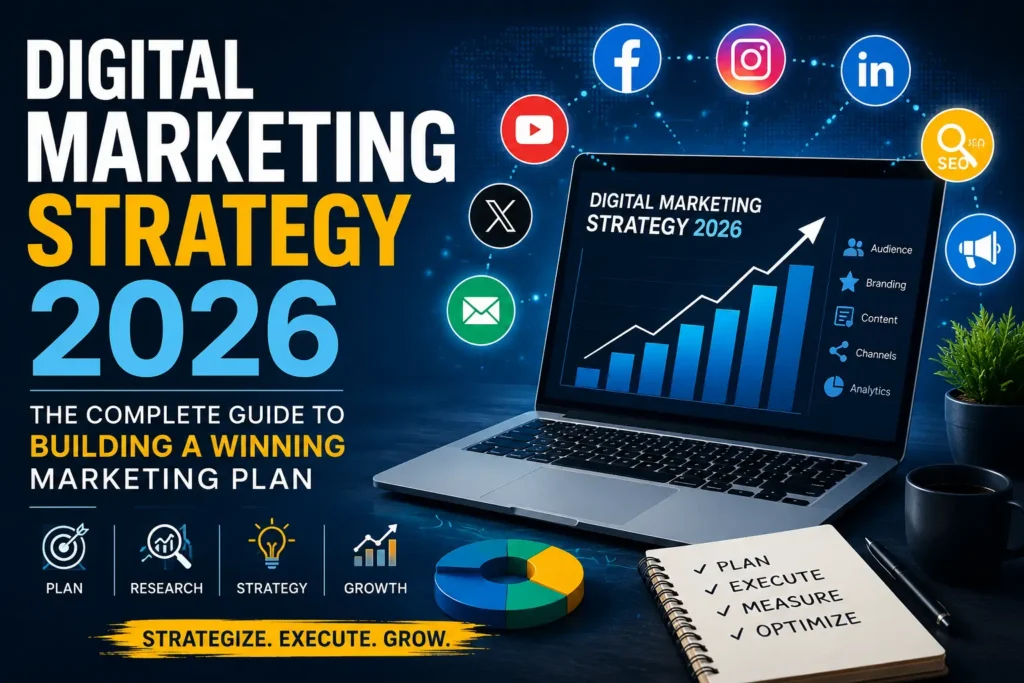
The digital landscape is changing. New algorithms take shape, new platforms emerge and consumer behavior changes overnight. But if your business is still dependent on year back strategies, then you are losing significant growth every day. The year 2026 has something new on the table and hence welcome to an era where a well-crafted Digital Marketing Strategy 2026 is the roadmap to sustainable business growth.
At Rank Blend, today we bring you the tips and strategies that will not only significantly enhance your traffic and build your brand, but convert this traffic into loyal, paying customers. In this guide, we shall walk you through the exact digital marketing strategies that work in 2026 and will help you build digital marketing plans that will deliver measurable results for your business.
Why Digital Marketing Strategy 2026 demands a different approach?
There need to be something new in your Digital Marketing strategy in 2026 as the year old strategies show the age factor. Here’s why 2026 demands a fresh approach.
Dominance of AI-generated content: Keyword stuffing doesn’t work anymore as present day content requires depth, authority, and genuine human insight.
Search intent matters more: Users have become more interactive as they love questioning, especially with the help of Voice Assistant and and AI.
Priority on Privacy-first marketing: With third-party cookies largely phased out, first-party data strategies have become non-negotiable.
Short-form videos dominate: Videos have started dominating over written content in 2026 the form of reels, shorts etc.
So before thinking how to create a digital marketing strategy in 2026, you need to be well familiar with these shifts that not only make your strategy survive, but thrive in the competitive market. Let’s have a look at the step-by-step guide.
Step 1: Define Your Business Goals
Every effective digital marketing plan for business needs to have clarity. Before crafting any content idea, you need to understand how to turn it into a masterpiece.
Ask yourself:
- What you are looking for? Generating leads, build brand awareness or drive e-commerce sales?
- What revenue targets do you set to achieve with this marketing plan?
- What’s your timeframe to measure the outcome? 3 months, 6 months, an year?
At Rank Blend, we insist people to to work smart and hence to focus on specific, measurable, achievable, and time-bound targets. For instance, instead of focusing on “getting more website traffic,” they should eye on “Increasing organic traffic by 40% within six months via SEO and content marketing.”
Once your goals set, convert them into clear KPIs: organic sessions, conversion rate, cost per acquisition, email open rates, return on ad spend (ROAS), and so on.
Step 2: Know Your Audience
A digital marketing strategy 2026 with little understanding of your audience interests is like building a house without a proper blueprint. You have to go beyond just assumptions.
Prepare detailed buyer profiles like:
- Audience Interest — What problems your customers are facing and what they are trying to solve?
- Digital behavior — What platforms they use to solve these issues and when?
- Content preferences — What sort of content do they prefer? Long-form articles, infographics, short videos, or podcasts?
- Purchase journey — How long it will take them to validate their decision and how to make them convinced?
You must take help of tools like Google Analytics 4, Audience Insights, customer surveys, and CRM data to measure the authenticity of data. The more you understand your audience interests, the better will be your digital marketing plan for business.
Step 3: Make a Detailed Audit
A detailed Audit of your Digital presence is essential before you look forward. A thorough audit gives you some actual insights on what’s working and what not and from where deduce the biggest opportunities.
What your audit should cover?
- SEO performance — Technical stuffs like site speed, Backlinking, Core Web Vitals, and Rankings
- Social media — Content Performance, Follower and Engagement ratio and content performance
- Email marketing — Open rates, CTR, list health, and automation sequences
- Paid advertising — Cost Per Click, Return on Ad Spend (ROAS), and conversion data across Meta, Google and other platforms
- Web analytics — Active Users, Session duration, Bounce rate, and conversion funnel drop-off points.
At Rank Blend we suggest peers to make a thorough audit to identify “leaking buckets” so that budget is not wasted a business can get the best possible Return on Investment (ROI).
Step 4: Choose the Right Channels
One of the most common mistakes to avoid while figuring out how to create a digital marketing strategy in 2026 is not to try to be everywhere at once. So you must select channels wisely. You must know what to choose and what to avoid.
Search Engine Optimization (SEO)
SEO or Search Engine Optimization has always been the backbone of long-term digital growth. However in 2026, SEO is no longer about keywords only — it’s about authority, E-E-A-T (Experience, Expertise, Authoritativeness, Trustworthiness), and meeting search intent. A dynamic digital marketing plan for business need to have a robust content strategy based on semantic keyword clusters.
Content Marketing
Content is the king and drafting qualitative, expert-driven content is what makes you distinguished in this AI driven world. Blogs, case studies, whitepapers, and original content not only build trust and authority but helps long term visibility in Google SERP.
Social Media Marketing
Your Social Media strategy in 2026 should be platform-specific and you must know which platform to use for which purpose. For instance, LinkedIn to be used for for B2B thought leadership, Instagram and TikTok for storytelling, YouTube for long-form content and Facebook for brand building and lead generation.
Email Marketing and Automation
Email still considered as a trusted medium to deliver one of the highest ROIs for any digital platform. Use Automation to build segmented lists, nurture leads and use behavioral triggers to send the right message at the right time.
Paid Media
Paid advertising is the short-cut to success this date as it accelerates visibility and adds value to organic workflows. In 2026, performance driven campaigns, AI-centered bidding, and creative testing are essential know-hows of a healthy paid strategy.
Influencer and Collaborations
Social Media has changed the lookout for Influencer marketing as Micro and nano-influencers drive better conversions than mega-celebrities. Building authentic collaborations is now a core component of a modern digital marketing strategy 2026.
Step 5: Create a Content Calendar and Editorial Plan
Execution is impossible without an action plan and hence once your channels are selected, you need to work out on a content calendar that aligns properly to your business goal.
Your editorial plan should include:
- Content type (blog post, Reel, email newsletter, YouTube video)
- Topic and Target keyword
- Publishing date and POC
- Distribution channels
- Goal and CTA (sign up, book a call, make a purchase)
At Rank Blend, we recommend to prepare a 90-day plan. This keeps your strategy agile enough to respond to algorithm updates while maintaining consistency.
Step 6: Allocate Budget Strategically
Now comes the most important part, budget allocation. Your digital marketing plan for business can be strong only with resources behind it. Your budget allocation in 2026 should reflect your business stage and growth goals.
What growing businesses do?
Allocate 40–50% resource to channels with that bring sure sort ROI (usually SEO + email)
Spend 30–40% resource on paid campaigns to drive traffic faster and generate leads
Give 10–20% resource to content production and creatives
Keep 5–10% on testing new channels and rest of strategies.
We at Rank Blend suggest to keep note of every single penny spent and make monthly performance review to measure Return on Investment.
Step 7: Measure, Analyze, and Optimize Continuously
A digital marketing strategy 2026 is not a document that you file and forget. You have to keep yourself engaged until the final result is accomplished. The most successful businesses always focus on data driven calculations to bring the best out of the least.
Prepare a proper reporting deck.
Weekly — Traffic, leads, ad spend, and conversion snapshots
Monthly — In-depth analysis of channel performance against Key Performance Indicators (KPIs)
Quarterly — Full strategy review with goal recalibration in case of need
Take help of tools like GA4, Google Search Console, SEMrush, or a CRM to track performance. This will help you to make data driven analysis and focus more on KPIs.
Final Thoughts
Businesses that consider Digital Marketing as an investment, not an expense in 2026 will lead the ladder. The key elements of a successful digital marketing strategy 2026 are a well-researched audience, the right channel mix, quality content, flawless execution, and consistent optimization which compounds in value over time.